 George A. Miller has provided two theoretical ideas that are fundamental to cognitive psychology and the information processing framework.
The first concept is “chunking” and the capacity of short term memory. Miller (1956) presented the idea that short-term memory could only hold 5-9 chunks of information (seven plus or minus two) where a chunk is any meaningful unit. A chunk could refer to digits, words, chess positions, or people’s faces. The concept of chunking and the limited capacity of short term memory became a basic element of all subsequent theories of memory.
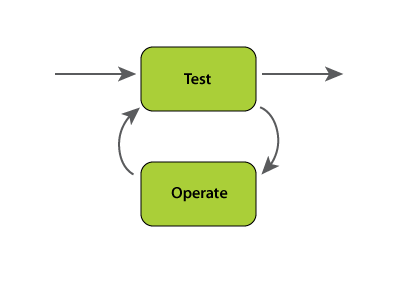
The second concept is TOTE (Test-Operate-Test-Exit) proposed by Miller, Galanter & Pribram (1960). Miller et al. suggested that TOTE should replace the stimulus-response as the basic unit of behavior. In a TOTE unit, a goal is tested to see if it has been achieved and if not an operation is performed to achieve the goal; this cycle of test-operate is repeated until the goal is eventually achieved or abandoned. The TOTE concept provided the basis of many subsequent theories of problem solving (e.g., GPS) and production systems.
Application
Information processing theory has become a general theory of human cognition; the phenomenon of chunking has been verified at all levels of cognitive processing.
Example
The classic example of chunks is the ability to remember long sequences of binary numbers because they can be coded into decimal form. For example, the sequence 0010 1000 1001 1100 1101 1010 could easily be remembered as 2 8 9 C D A. Of course, this would only work for someone who can convert binary to hexadecimal numbers (i.e., the chunks are “meaningful”).
The classic example of a TOTE is a plan for hammering a nail. The Exit Test is whether the nail is flush with the surface. If the nail sticks up, then the hammer is tested to see if it is up (otherwise it is raised) and the hammer is allowed to hit the nail.
Principles
- Short term memory (or attention span) is limited to seven chunks of information.
- Planning (in the form of TOTE units) is a fundamental cognitive process.
- Behavior is hierarchically organized (e.g., chunks, TOTE units).
References
- Miller, G.A. (1956). The magical number seven, plus or minus two: Some limits on our capacity for processing information. Psychological Review, 63, 81-97.
[Available at http://www.musanim.com/miller1956] - Miller, G.A., Galanter, E., & Pribram, K.H. (1960). Plans and the Structure of Behavior. New York: Holt, Rinehart & Winston.
Related Websites
For more on Miller and his work, see http://en.wikipedia.org/wiki/George_Armitage_Miller